
Three years ago I revealed how the secret Foreign Office propaganda unit IRD (Information Research Department) subverted the British libel courts and sought to traduce the historian David Irving’s reputation.
This month documents released at the UK National Archives in Kew, southwest London, show that even a decade after IRD’s abolition, sections of the Foreign Office assisted a propaganda campaign against another controversial historian, Count Nikolai Tolstoy.
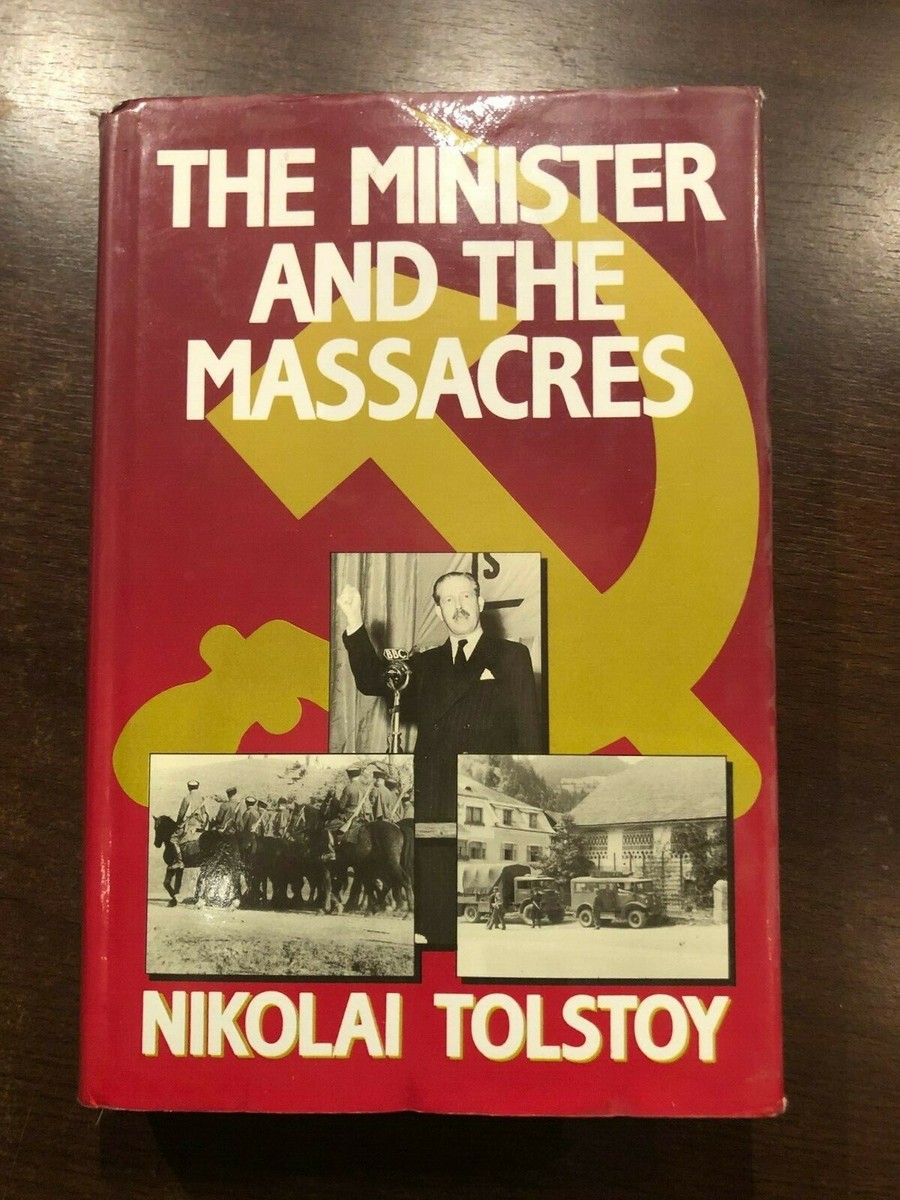
This concerned Count Tolstoy’s pioneering investigation into the disgraceful betrayal of Cossack and Yugoslav prisoners at the end of the Second World War. In three books – Victims of Yalta (1977), Stalin’s Secret War (1981), and The Minister and the Massacres (1986) – Count Tolstoy sought to piece together a story that had been suppressed in previous British accounts.

This became especially controversial because of the central roles of two men who later reached the summit of British politics and finance. In 1945 Harold Macmillan was British resident minister in the Mediterranean: he held secret discussions in May 1945 with Field Marshal Harold Alexander (supreme commander of Allied forces in the Mediterranean), and Gen. Charles Keightley (commander of the British Eighth Army’s V Corps, which was on the front line of the Western Allied advance in Austria).
On advancing into Austria in the spring of 1945, Keightley’s V Corps had captured thousands of Cossacks, as well as Serbian Chetniks and Croatian nationalists who had also fought on the German side.
In these discussions Macmillan encouraged Keightley to hand over Cossack prisoners to Soviet forces – knowing they would face torture and execution – and likewise to hand over Serbs and Croats to Tito’s Yugoslav communists. This was said to be in accordance with the Anglo-Soviet agreement at the Yalta Conference earlier that year, but the controversial thesis of Count Tolstoy’s books was that Macmillan and others had ignored a decision made in London that only prisoners who were Soviet citizens should be repatriated. In the event, the Cossacks were handed over as a group, including men, women and children who held French or other citizenship.
The Serbs and Croats were similarly betrayed. Writing in The Spectator in 1995, the former MP and publisher Nigel Nicolson (who unlike Low and Macmillan was clearly repentant for the terrible events in which he had been ordered to participate) wrote:
“Fifty years ago I was a captain in the British Army, and with others I supervised the Jugoslav (Yugoslav) ‘repatriation’, as it was euphemistically called. We were told not to use force, and forbidden to inform them of their true destination. When they asked us where they were going, we replied that we were transferring them to another British camp in Italy, and they mounted the trains without suspicion. As soon as the sliding doors of the cattle-trucks were padlocked, our soldiers withdrew and Tito’s partisans emerged from the station building where they had been hiding, and took over command of the train.
“The prisoners and refugees could see them through cracks in the boarding, and began hammering on the insides of the wagons, shouting abuse at us for having betrayed them, lied to them, and sentenced at least the men among them to a grotesque death. There is now no doubt about their hideous fate, and to those of us on the spot there was little doubt then. Shortly after the first trainloads had been despatched, we heard the stories of the few survivors who escaped back to Austria, and thousands of manacled skeletons have since been disinterred in Slovenian pits.”
Macmillan of course went on to become Prime Minister from 1957 to 1963, and by the time of Count Tolstoy’s books he was a venerated elder statesman of the Conservative Party.
Also at the centre of this controversy was wartime Brigadier Toby Low, who postwar became Conservative MP for Blackpool North (1945-62) before being elevated to the peerage by Macmillan in 1962 as Lord Aldington. He served as deputy chairman of the Conservative Party, and after ceasing to be an MP took on several very prominent roles in finance and industry, including as chairman of his family-linked bank Grindlays (now part of Standard Chartered), the giant conglomerate GEC, the Sun Alliance insurance company, and the Port of London Authority.
Low was one of the senior officers on the ground in Austria, implementing the handover of prisoners to the Russians.
Macmillan died (aged 92) in December 1986, and a few months later it was Aldington (the former Brig. Toby Low) who took centre stage, after a businessman named Nigel Watts circulated a pamphlet attacking Aldington, and the latter brought a widely publicised libel action.
Watts wasn’t himself a historian – he produced the pamphlet (largely drawn from his reading of Count Tolstoy’s books) as part of a long-running dispute with the insurance company that Aldington chaired.
Count Tolstoy felt that as a matter of honour he should associate himself with Watts’s case, since the latter would lack the necessary historical knowledge to defend himself.

The outcome was one of the largest libel awards in English history. After a jury trial in October-November 1989, Aldington was awarded £1.5 million, plus costs. Various appeals and further actions (including bankruptcy proceedings against both Watts and Count Tolstoy) followed. In July 1995 the European Court of Human Rights found unanimously that the English libel courts had violated Count Tolstoy’s right to freedom of expression – although as in all such cases, the ECHR lacked the power to overturn the libel jury’s decision or to reduce the damages. Count Tolstoy resolutely refused to pay a penny of damages while Aldington was alive: two days after Aldington’s death, he was forced by court order to pay £57,000 to his adversary’s estate.
Following this month’s release of Foreign Office documents, there are serious questions to ask about official involvement in a propaganda campaign against Count Tolstoy – a campaign which in seeking to defend Macmillan also assisted Aldington’s 1989 libel action. As with the earlier IRD targeting of David Irving, there are now serious questions about the way in which Britain’s secret state targets dissidents and (directly or indirectly) exercises an improper influence on court proceedings.
The document trail begins in July 1974 when Thomas Barker – the head of IRD (Information Research Department), a top secret propaganda unit of the Foreign Office working closely with other British intelligence services – wrote to the head of the Foreign Office, Sir Thomas Brimelow, to alert him about a possible press article by Count Nikolai Tolstoy. Then aged 39, Count Tolstoy was at that time relatively little known: in fact in this IRD file he is at first misidentified as “Michael Tolstoy”.
IRD’s modus operandi involved recruiting a range of contacts in the British and international press, who were granted special favours in return for acting as propaganda funnels and sometimes (as on this occasion) spying on fellow journalists, authors, and academics.
On this occasion the informant was one of IRD’s regular assets, the Sunday Telegraph journalist, historian and biographer Gordon Brook-Shepherd, and the story had developed out of a Sunday Telegraph review of the famous book The Gulag Archipelago by renowned Soviet dissident Aleksandr Solzhenitsyn.
Stephen Vizinczey had ended his Telegraph review thus:
“Yet one of the most appalling episodes in this book is the British Army’s betrayal of 90,000 unsuspecting White Cossacks who were waylaid into the hands of the NKGB in May 1945, in Austria:
“’The British proposed first that the Cossacks give up their guns on the pretext of replacing them with standardised weapons. Then the officers… were summoned to a supposed conference in the city of Judenberg in the British Occupation zone. But the British had secretly turned the city over to the Soviet armies the night before. Forty busloads of officers drove straight down into the semi-circle of Black Marias… The officers didn’t even have anything with which to shoot themselves or stab themselves to death, since their weapons had been taken away.’
“Later the enlisted men were delivered to the NKGB stockyards in a similarly treacherous fashion. No doubt there was a Good Reason for it. The moral sickness of our century is expediency, and it knows no political boundaries.”
Brook-Shepherd informed his IRD masters that soon after publishing this review, his newspaper had “just been approached by a White Russian émigré, Michael Tolstoy [sic], who attempted to sell it a violently anti-British article elaborating on the Solzhenitsyn account, incidentally mentioning the PUS [Permanent Under-Secretary at the Foreign Office, Sir Thomas Brimelow] by name as one of those concerned on the British side. Brook-Shepherd feels that the PUS should know about this in case Tolstoy finds a ‘buyer’ elsewhere in the Press.”

Barker arranged for Brook-Shepherd to be given an unattributable briefing so that in due course he could write a rebuttal to whatever might be published from Count Tolstoy. This briefing was based on information from Sir Thomas Brimelow, but the Foreign Office mandarin was very cautious and made sure it was conveyed via a cut-out (a former intelligence analyst turned academic ‘Kremlinologist’, Malcolm Mackintosh).
Brimelow explained to IRD that he had declined to be interviewed by Count Tolstoy. He knew that the subject of the repatriation of Cossack prisoners was soon to be written about in a book by Nicholas Bethell (the Tory peer Lord Bethell). In fact it was the imminent appearance of this Bethell book, and its serialisation in the rival Sunday Express, that led to the Sunday Telegraph dropping any interest in either an article by Count Tolstoy or a reply by Brook-Shepherd.
In 1978 Count Tolstoy’s book Victims of Yalta was published, based on the first set of document releases from the immediate postwar period. One of the central revelations was that the British authorities (notably then Foreign Secretary Anthony Eden) seemed to have agreed enthusiastically to repatriate to the USSR all Russian soldiers in British hands, even though Stalin and his minions had made no such demand as their quid pro quo for returning those British prisoners of war who had fallen into the hands of the Red Army during 1944-45.
British officials implementing Eden’s policy were keen to conceal the fact that numerous Russians had committed suicide when they realised they were being handed over to the Soviet butchers. Patrick Dean, for example, a high-flying diplomat who ended up British Ambassador in Washington, wrote that every posible step should be taken to prevent publicity about the suicides and to hush up the consequent coroners’ inquests: “these suicides might possibly cause political trouble”.
Fellow diplomat Geoffrey Wilson (who in later life became chairman of the UK’s Race Relations Board) took on the task of passing on advice to coroners that they should instruct the press “it would be better not to report these cases” – a tactic that “had worked successfully before”.
In his initial research during 1975-76, Count Tolstoy had found it impossible to trace the documentary record of Harold Macmillan’s involvement in the repatriations. The newly released Foreign Office files pick up this trail.

In a second (1979) edition of Victims at Yalta and in his 1981 follow-up Stalin’s Secret War, Count Tolstoy began to focus on Macmillan’s role – which was to become the most publicised aspect of his even more controversial The Minister and the Massacres in 1986.
In 1978 (following interest aroused by Victims of Yalta) the Foreign Office and MI6 had advised then Foreign Secretary David Owen that four files on Yalta-related matters must continue to be withheld. However, these were said not to relate to the allegations against Macmillan and others.
Macmillan himself wrote to Mrs Thatcher’s Cabinet Secretary, Sir Robert Armstrong in 1980 seeking access to certain papers related to the 1945 repatriations. The newly released files show that the Ministry of Defence had limited success in tracking down such files, either because they had been deliberately suppressed, or lost, or destroyed in routine ‘weeding’ over the years.
Macmillan claimed that he was seeking these documents not to engage in public controversy with Count Tolstoy or others, but to assist his official biographer (Alistair Horne) in his eventual task of piecing together Macmillan’s side of the story.
However, other revelations in the new document releases suggest that Macmillan was (not unusually) being disingenuous. There is clear evidence that just as a cabal of former civil servants and intelligence officers conspired to defend Churchill’s reputation and traduce David Irving in the late 1960s and early 1970s (with the help of IRD), a similar alliance of former diplomats and intelligence officers/assets conspired in a propaganda drive against Count Tolstoy in the late 1980s, again with covert Foreign Office backing (though IRD by this time no longer existed under that name).
In 1986 Anthony Cowgill, a retired Brigadier active in Tory and nominally ‘right-wing’ circles, introduced himself to Count Tolstoy – supposedly as someone who had a genuine interest in the Minister and the Massacres book and was sympathetic to the case. The precise circumstances of how Cowgill was recruited into this saga and how he first met Count Tolstoy are not clear, but it seems to have occurred soon after the banning of a Conservative Party fringe meeting on the issue. It’s likely that Cowgill’s longstanding friendship with Prime Minister Thatcher’s influential press secretary Bernard Ingham had some bearing on his being chosen for the task. Thatcher took a personal interest in suppressing the story and preserving Macmillan’s reputation, as did her party chairman Norman Tebbit.
Within a short time Cowgill put together a research committee which spent the next four and a half years compiling a systematic assault on Count Tolstoy’s thesis. The other members of the committee were:
- Brigadier Edward Tryon (who later changed his name to Tryon-Wilson), who like Toby Low had served with V Corps in Austria and had personally liaised with his Soviet counterparts over the repatriations.
- Lord Brimelow (the former Sir Thomas Brimelow), who had been the Foreign Office ‘expert’ most concerned with the implications of the Yalta agreement, including the repatriations, and who (as mentioned above) had been among the first officials alerted by IRD and its informants about Count Tolstoy’s work as far back as 1974.
- Christopher Booker, the journalist and co-founder of Private Eye, who again started out nominally sympathetic to Count Tolstoy’s argument but whose late sister (significantly) was a researcher for Macmillan’s official biographer Alistair Horne.

A whole series of recently released documents confirms that while it was nominally an independent and private initiative, Cowgill’s committee was soon given the official seal of approval. In September 1987 the official Foreign Office historian Pat Andrews wrote to senior Cabinet Office civil servant Trevor Woolley that the Ministry of Defence “have apparently given it semi-official status and have provided facilities for research and some access to records”.
By contrast when Nigel Watts (Count Tolstoy’s co-defendant) wrote to his MP and other politicians and officials in 1986, an expert from the Soviet department of the Foreign Office (Michael Llewellyn-Smith) advised that the government should avoid any direct reply to his allegations and should not be “drawn into the questions of fact or interpretation (which are a historical minefield). This would require an immense amount of work and would simply feed further controversy and correspondence.”
Evidently there was one rule for Watts and Tolstoy, and another for Cowgill and his committee who were setting out to rubbish their thesis.
In this same August 1986 memo, Llewellyn-Smith passed on a confidential letter that Brimelow had sent to Aldington, in which the veteran Foreign Office mandarin admitted “that there is much uncertainty (resulting largely from the absence of documentation) surrounding Lord Stockton’s [i.e. Harold Macmillan’s] actions and the extent to which he was aware of Churchill’s instructions. He also makes the point that it is in part because the surviving papers leave so much unexplained that Tolstoy has had scope for his insinuations.”

This was at exactly the time when Brimelow was joining Cowgill’s supposedly “independent” investigating committee. Cowgill told Miss Andrews that he hoped his committee’s research would help Lord Aldington’s libel action but added that he thought Aldington “had been his own worst enemy”, implying that he thought Aldington ought to settle the action and might well lose.
In the summer of 1988 Cowgill informed Miss Andrews that he had been allowed to see unpublished documents contained in Macmillan’s private archive at his country home, Birch Grove. Following the former Prime Minister’s death in December 1986 his grandson and heir (Lord Stockton) and his official biographer Horne were engaged in the long task of cataloguing these papers.
The Foreign Office was alarmed to discover that “the Macmillan collection contains public records, perhaps even some original records of which we have no copies; one of the letters brought in by Brigadier Cowgill is one for which the FCO has been searching for years.”
Some of these related to Macmillan’s time as British resident minister in the Mediterranean at the end of the war. The Cabinet Secretary (Sir Robin Butler) wrote to Lord Stockton to ensure that the government had access to these papers before they were handed over to a university archive, so that any remaining secret material could be withheld.
Even today, the published record isn’t clear about the full extent of British official knowledge of exactly who decided (and when) to repatriate the Cossacks, Serbs and Croats. For example, Miss Andrews refers obliquely to a study of the subject written for internal Foreign Office use by its official historian and archivist Dr Rohan Butler, but I have not read this document and don’t know whether it is available in unredacted form.

No copy of the agreement between Gen. Alexander and the Russians survived in any Foreign Office archives, and many other relevant records were missing – though (very conveniently) the Cowgill committee obtained access to the office files of Macmillan’s US counterpart Alexander Kirk, which contained material missing from the UK archives, as well as notes that Kirk made on some of the repatriation discussions.
It’s apparent from the newly released Foreign Office documents that neither Cowgill nor the other members of his team (including Booker who was a professional journalist) did their own research at Kew in the normal manner. Instead, throughout the four years of their inquiry, they were specially aided (in effect spoon fed) by the Foreign Office, Cabinet Office, and Ministry of Defence, who obtained the relevant files for them and brought them to Whitehall for Cowgill to inspect at his convenience.
These once-secret files included the first protest to Churchill about the repatriations – a letter to Churchill (who had returned to office as peacetime Prime Minister) in February 1953 from the head of a Cossack émigré organisation in New York. The version of 1945’s events described in this letter, including the way British officers tricked Cossacks in Linz by inviting their officers to what they thought was going to be a meeting with a British General, before disarming them and handing them over to the Red Army, was similar to the story told by Solzhenitsyn many years later in The Gulag Archipelago.
Six years later in 1959 (by which time Macmillan was Prime Minister) a Cabinet Office historian F.S.V. Donnison returned to the subject, requesting the War Office to send copies of any files they had on the topic and asking: ““Do we know what did in fact happen to them [the Cossacks]? Were they butchered as we expected? …None of the papers I have seen say what in the end happened – though all, obviously, feared the worst.”
In 1960 another Cabinet Office historian, Brig. Harry Latham, noted that men, women and children had been handed over to Stalin’s forces, and that British troops had needed to use “considerable force” to compel the Cossacks to accept repatriation.
The few existing documents from Field Marshal Alexander indicate that in May 1945 the supreme commander of Allied Forces in the region was aware that the repatriations involved “approximately 50,000 Cossacks including 11,000 women, children, and old men”; plus about 35,000 Serbian Chetniks and about 25,000 Croat troops. The Field Marshal sent a telegram to the Combined Chiefs of Staff in Washington (with copies to the heads of the Foreign Office, War Office, and Admiralty in London) noting that “in each of the above cases to return them to their country of origin immediately might be fatal to their health.”
Though important documents are still missing from the file, it seems that on 20th June 1945 the Combined Chiefs in Washington replied retrospectively approving the repatriation actions that Field Marshal Alexander had already taken.

It wasn’t until October 1990 – after four and a half years of work, assisted at every stage by civil servants in at least three Whitehall departments – that Cowgill’s team submitted their final report, predictably exonerating Macmillan and Aldington. Officials wrote to Cowgill in advance of this publication, emphasising that he should avoid any hint that he had official approval, as this “might seem to prejudice the independent nature of his work”.
However, in a private letter to another civil servant that has only now been declassified, Foreign Office historian Pat Andrews wrote that “although this is not an official enquiry – indeed great pains have been taken to ensure its independence – it has been given high level official blessing, including that of the Prime Minister.”
The IRD propaganda unit was long dead – but the same conspiratorial spirit that had led IRD to coordinate the campaign against David Irving in the 1960s and early ’70s, was alive and well in the Foreign Office of the late 1980s, this time with Count Nikolai Tolstoy as the target.
It is to be hoped that further documents will be released about Whitehall’s determination to mould 20th century history. Especially when such efforts involved potentially subverting court cases, the British people are entitled to know what was being done in their name.

